
A standard homeowners policy bundles six core coverages: dwelling, other structures, personal property, loss of use, personal liability, and medical payments. It almost never covers flood or earthquake damage, which require separate policies or endorsements. What you actually collect after a loss depends less on which coverages you have and more on your limits, your deductible, and whether your property is valued at replacement cost or actual cash value.
TL;DR:
- Your homeowners policy's payout depends more on limits, deductibles, and valuation methods than on the coverages included.
- Flood and earthquake damage are not covered and require separate policies or endorsements, especially in high-risk areas.
- Standard policies often exclude sewer backup, wear-and-tear damage, and law-mandated code upgrades unless specific endorsements are added.
- Replacement cost coverage avoids depreciation but can be insufficient without inflation guards or guaranteed replacement policies.
- An independent agent can help tailor coverage to your risks, prioritizing dwelling, liability, and scheduled valuables based on your situation.
Table of Contents
- Homeowners Insurance Coverages Explained: Coverage A Through F
- What Do Homeowners Insurance Exclusions Look Like?
- How Do Deductibles and the 80% Rule Affect Your Payout?
- What Happens After You File a Homeowners Claim?
- How Does an Independent Agent Help You Pick the Right Coverage?
- Which Coverage Should You Prioritize First?
- Ready to Review Your Own Coverage?
- Where to Verify Homeowners Coverage Details
- Sources
- FAQ
Homeowners Insurance Coverages Explained: Coverage A Through F
Every standard policy is built from six coverage sections labeled A through F. They sound like alphabet soup on the declarations page, but each one answers a specific question about what gets paid and when.
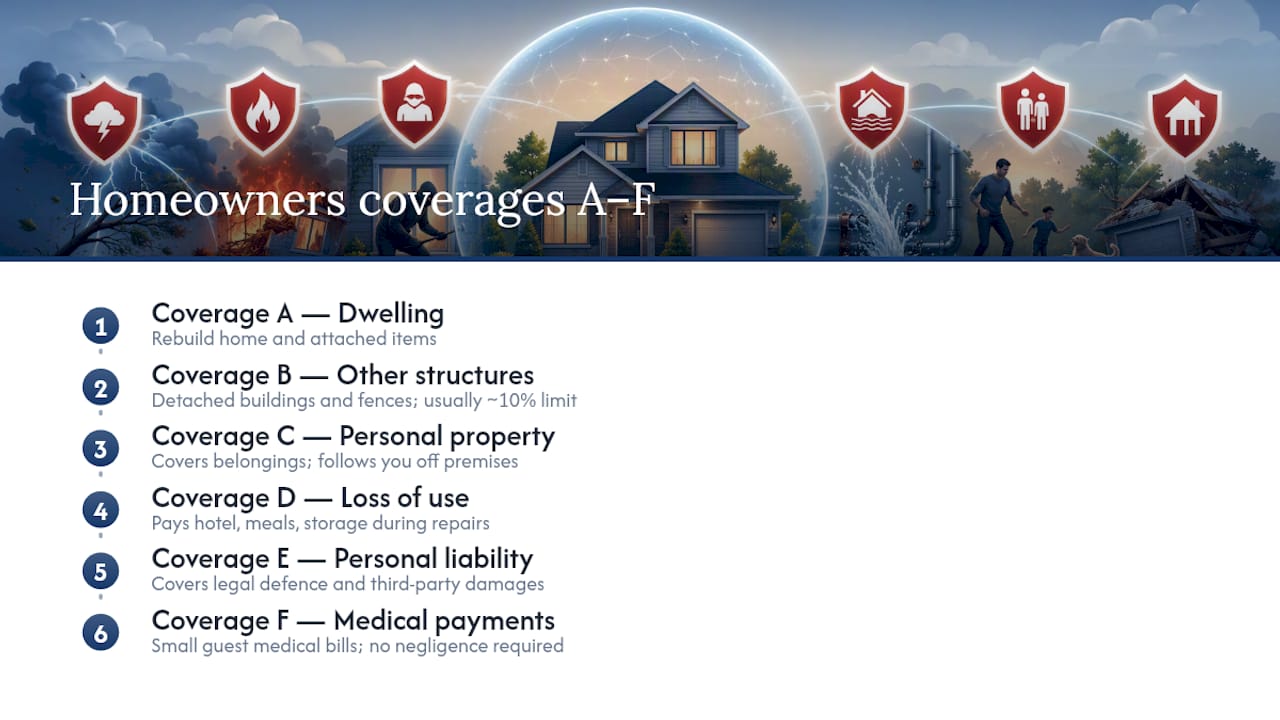
Coverage A, dwelling, pays to rebuild your house and anything permanently attached to it, like built-in cabinets or an attached deck, after a covered loss such as fire, hail, or lightning. This is usually the largest number on your policy and the one your mortgage lender cares about most.
Coverage B, other structures, handles detached garages, sheds, and fences. Insurers typically set this limit at around 10% of your dwelling coverage automatically, though you can usually raise it if you have a pool house or a large workshop.
Coverage C, personal property, covers your belongings, furniture, electronics, clothing, and everything else you'd have to replace after a fire or theft. It's typically set at a significant portion of your dwelling limit and generally follows you off premises, so a laptop stolen from your car is usually covered too. High-value items like fine jewelry or art often need a separate scheduled endorsement, since standard policies cap payouts for those categories at just a few thousand dollars.
Coverage D, loss of use, also called additional living expenses, pays for hotel stays, restaurant meals, and temporary storage while your home is being repaired. Most policies cap this at a portion of your dwelling limit or a certain duration, so check both numbers before assuming you're fully protected during a long rebuild.
Coverage E, personal liability, protects you if someone is injured on your property or you accidentally damage someone else's property, and it also pays legal defense costs if you're sued. Many policies start liability limits at a baseline amount, which may be insufficient for homeowners with significant assets.
Coverage F, medical payments, covers small medical bills for guests hurt on your property, regardless of fault. Unlike liability coverage, medical payments require no negligence finding, which lets you settle a minor injury quickly instead of turning it into a liability claim.
What Do Homeowners Insurance Exclusions Look Like?
Standard policies are written around either named perils or open perils, and the difference matters more than most homeowners realize. A named-perils policy lists exactly what's covered, fire, windstorm, theft, and anything not on that list is excluded by default. An open-perils policy (common in HO-3 and HO-5 forms) covers everything except what's specifically excluded, which generally gives you broader protection, but you still have to read the exclusions section closely.
The most consequential gaps in a standard policy are consistent across nearly every insurer:
- Flood damage is excluded outright. Coverage requires a separate policy through the National Flood Insurance Program or a private flood insurer, and lenders in FEMA-designated flood zones typically require it as a condition of the mortgage.
- Earthquake and earth movement are excluded and require a standalone earthquake policy or endorsement, especially relevant in seismically active regions.
- Sewer and drain backup is excluded by default. A backed-up sewer line can cause tens of thousands of dollars in damage, and the endorsement to cover it is often inexpensive relative to the risk.
- Wear and tear, and pest damage are treated as maintenance issues, not insurable losses, since insurance is built for sudden and accidental events.
- Ordinance or law changes aren't automatically covered. If a rebuild has to meet updated building codes, an ordinance and law endorsement pays the difference.
Scheduled personal property endorsements fill another common gap, raising or removing the caps on jewelry, collectibles, and other valuables that Coverage C limits severely.
How Do Deductibles and the 80% Rule Affect Your Payout?
Your coverage limits mean little if your valuation method and deductible work against you. Replacement cost coverage pays to rebuild or repair without subtracting for depreciation. Actual cash value pays replacement cost minus depreciation, so a 10-year-old roof might only net you a fraction of what a new one costs.
Fall below that threshold and a coinsurance penalty kicks in, reducing your payout proportionally even on a partial loss.
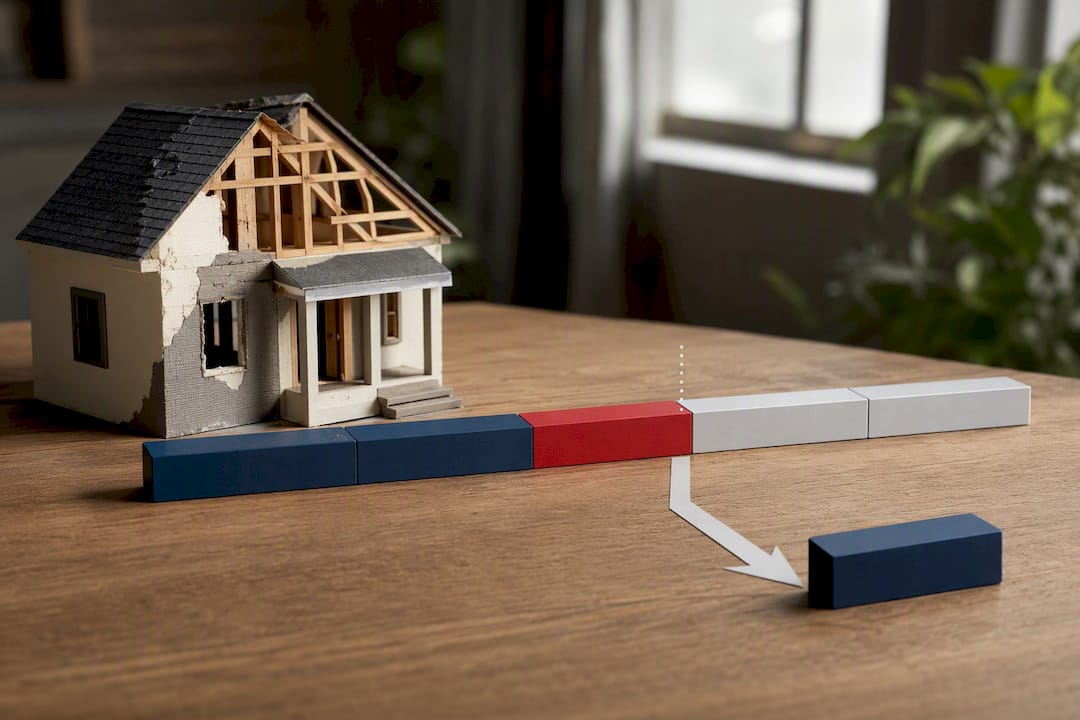
Construction costs tend to climb faster than homeowners expect, and after major regional disasters, rebuilding costs can spike well beyond original policy limits. An inflation guard or extended replacement cost endorsement adds a cushion, typically 25% to 50% over your stated limit, for exactly that scenario. Guaranteed replacement cost, where available, removes the cap entirely.
What Happens After You File a Homeowners Claim?
The steps right after a loss shape how smoothly your claim moves.
- Stop further damage first: tarp a roof, shut off water, board up broken windows. Insurers expect reasonable mitigation and can reduce payouts if damage worsens from inaction
- Photograph everything before you clean up or start repairs, including close-ups of serial numbers on damaged electronics or appliances.
- Pull together receipts, a home inventory, and your policy's declarations page. Thorough documentation speeds up claims processing and reduces disputes over value.
- Expect the adjuster to inspect the damage, cross-check your documentation, and estimate repair costs against your policy's valuation method.
- Report promptly. Delayed reporting, missing maintenance records, or thin documentation are the most common reasons claims get reduced or denied.
Simple claims often resolve in a few weeks; major structural losses can take months, particularly when contractors are backlogged after a regional disaster.
How Does an Independent Agent Help You Pick the Right Coverage?
Comparing coverage on your own means reading fine print across insurers with different exclusion lists, endorsement pricing, and underwriting rules. An independent agency shops multiple carriers at once and matches endorsements, like sewer backup, scheduled jewelry, or umbrella liability, to your actual risk instead of a generic template.
An independent agency with access to multiple top-rated carriers provides personalized coverage options and aims for same-day responses on inquiries. If your situation is straightforward, a standard quote comparison may be all you need. If it's not, that's when a second set of eyes on your declarations page pays for itself.
Which Coverage Should You Prioritize First?
First-time buyers should lock in adequate dwelling and liability limits before anything else. Families with growing assets should revisit liability limits and consider an umbrella policy once a lawsuit could threaten savings beyond the standard $100,000 baseline. Collectors and anyone with jewelry worth more than a few thousand dollars need a scheduled property endorsement, full stop, because Coverage C alone will disappoint you at claim time.
— Nathan
Ready to Review Your Own Coverage?
Reading through six coverage letters and a list of exclusions is one thing. Knowing whether your specific dwelling limit, deductible, and endorsements actually match your risk is another, and that's the gap Quality Insurance Agency exists to close. As an independent agency, we compare options across multiple top-rated carriers at no extra cost to you, and we respond to inquiries the same day you reach out.

Before you call, pull together three things: a rough home inventory, your current declarations page if you have an existing policy, and a list of anything valuable, jewelry, art, collectibles, that might need a separate scheduled property endorsement. If you rent out part of your home or run a business from it, mention that too, since it can affect what standard coverage will and won't touch. From there, get a tailored homeowners insurance quote and find out whether your current limits actually hold up against the 80% rule.
Where to Verify Homeowners Coverage Details
- NAIC: breaks down the six standard coverage types and coinsurance rules.
- FEMA: explains flood insurance eligibility and NFIP basics.
- Texas Department of Insurance: consumer guidance on replacement cost, ACV, and claims documentation.
- Triple-I: detailed handbook on policy structure and valuation.
Sources
- Insurance Topics | Homeowners Insurance | NAIC
- Triple-I homeowners insurance handbook (2023)
- FEMA — flood insurance
- Home insurance guide (Texas Department of Insurance consumer bulletin)
FAQ
What Coverages Are Included in a Homeowners Insurance Policy?
A standard policy includes six coverages: dwelling (A), other structures (B), personal property (C), loss of use (D), personal liability (E), and medical payments (F).
Is $100,000/$300,000/$50,000 Liability Coverage Enough?
Coverage limits in that range work for many homeowners with average assets, but anyone with significant savings, home equity, or a higher-risk property (a pool, a trampoline, frequent guests) should consider an umbrella policy for added protection beyond standard limits.
What Is the Most Important Coverage for Homeowners Insurance?
Dwelling coverage (A) is the foundation since it funds rebuilding your home, but personal liability (E) is what protects your broader financial assets if you're found responsible for someone else's injury or property damage.
Does Homeowners Insurance Cover Flood or Earthquake Damage?
No. Both are standard exclusions, and coverage requires a separate flood policy, typically through the National Flood Insurance Program, or a standalone earthquake policy or endorsement.